


Accra, Ghana | August 11, 2026
The Ghana Hubs Network (GHN) welcomes the Government of Ghana’s initiative to develop a framework for the productive use of funds held in dormant bank accounts, provided that the rights of account holders remain fully protected and the process is governed by strong transparency and accountability safeguards. The Ministry of Finance has indicated that the proposed framework will seek to use eligible dormant funds in the public interest while preserving the ability of rightful owners to reclaim their assets.
However, GHN believes the government should give serious consideration to directing a significant portion of these funds towards innovation, entrepreneurship and enterprise development.
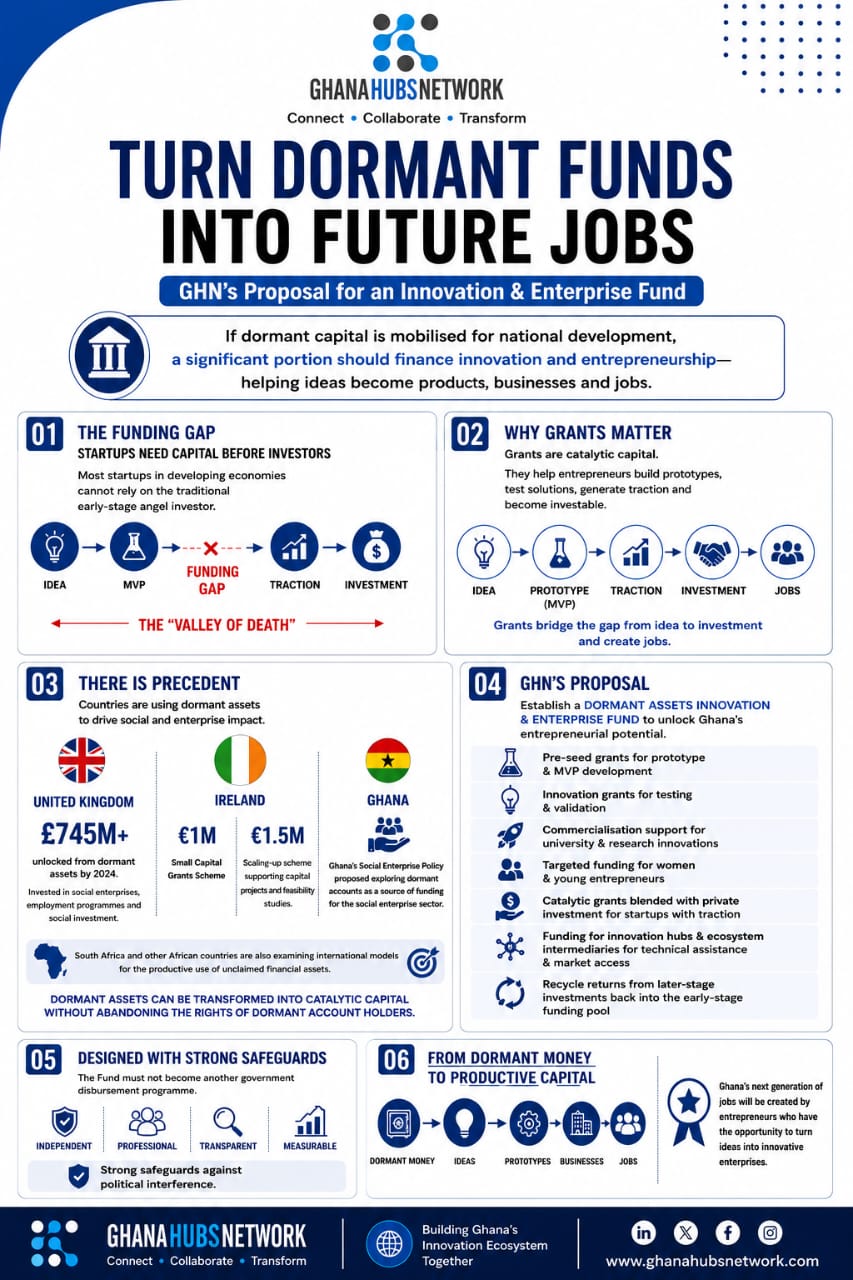
Our argument is simple: if dormant capital is going to be mobilised for national development, it should help create the productive capacity that Ghana needs for the future.
Ghana’s entrepreneurs are not short of ideas. They are short of the patient, risk-tolerant capital required to turn those ideas into viable products, businesses and jobs.
We need to fund the journey from idea to investment.
The traditional startup funding narrative often assumes a neat progression from founder → angel investor → venture capital → growth capital. That pathway does not adequately reflect the realities of entrepreneurship in developing economies.
As Dr Gordon Adomdza, Executive Director of CEIBS Africa and former Associate Professor of Entrepreneurship at Ashesi University, puts it:
“If you study the theoretical funding cycle for a startup, you would realise that most startups in the developing world would not encounter the traditional early-stage angel investor. They would need free funding, such as grants, to develop and test their MVPs and gain enough traction to attract traditional investors. Sadly, the grant space is dwindling. There is a need for more grant-like vehicles to support startups to leap over the valley of death.”
This is the policy gap Ghana should address.
Grant funding should not be viewed as an end in itself. It is a catalytic capital. It allows an entrepreneur to build and test a prototype of a market-oriented solution/product, generate initial traction, develop intellectual property and demonstrate sufficient potential to become investable.
Only then does conventional private capital become more realistic.
There is international precedent.
The idea is not without precedent.
In the United Kingdom, the Dormant Assets Scheme has redirected dormant funds towards social and environmental initiatives, including social enterprises, employment programmes and social investment. More than £745 million had been unlocked from dormant assets by 2024.
The UK has also used dormant assets to strengthen its social investment infrastructure, including Better Society Capital, while its current strategy allocates £87.5 million to grow social investment in community enterprises and mission-driven businesses.
Ireland provides an even closer example. Its Dormant Accounts Fund has been used to provide grants to social enterprises, including a €1 million Small Capital Grants Scheme and a €1.5 million scaling-up scheme supporting capital projects and feasibility studies.
Within Africa, Ghana itself has previously recognised this policy opportunity. Ghana’s Social Enterprise Policy proposed that the Government should explore dormant accounts as a source of funding for the social enterprise sector. South Africa has likewise examined international models for the productive use of unclaimed financial assets as part of its policy development around unclaimed assets.
These experiences demonstrate an important principle: dormant assets can be transformed into catalytic capital without abandoning the fundamental obligation to protect their rightful owners.
GHN’s proposal
GHN therefore calls on Government to consider establishing a Dormant Assets Innovation and Enterprise Fund as part of the emerging framework.
Such a mechanism could provide:
- Pre-seed grants for prototype and MVP development;
- Innovation grants for testing and validation;
- Commercialisation support for university and research-based innovations;
- Targeted funding for women and young entrepreneurs;
- Catalytic grants blended with private investment for startups that demonstrate traction;
- Funding for innovation hubs and ecosystem intermediaries that provide technical assistance and market access; and
- A mechanism to recycle returns from later-stage investments back into the early-stage funding pool.
Importantly, this should not become another conventional government disbursement programme.
The fund should operate independently, professionally and transparently, with clear investment and grant-making criteria, measurable outcomes, private-sector participation and strong safeguards against political interference.
From dormant money to productive capital
Ghana cannot afford to continue treating innovation entrepreneurship primarily as a matter of training people to write business plans while leaving them without the capital to test whether their market-oriented ideas can actually work.
If properly designed, dormant assets could help Ghana finance the difficult zero-to-one journey. The stage at which an idea becomes a prototype, a prototype becomes a product, and a product begins generating customers, revenue and jobs.
The objective should not simply be to deploy dormant funds. It should be to convert dormant capital into productive capacity.
GHN therefore encourages the Ministry of Finance, Bank of Ghana, financial institutions, development partners, investors, innovation hubs and the wider ecosystem to make innovation and entrepreneurship a central consideration in the ongoing policy design.
Ghana’s next generation of jobs will not be created by capital sitting idle in accounts. They will be created by entrepreneurs who have the opportunity to turn ideas into innovative enterprises.
Ghana Hubs Network
www.ghanahubsnetwork.com
info@ghanahubsnetwork.com
+233244480475
Building Ghana’s Innovation Ecosystem Together
