


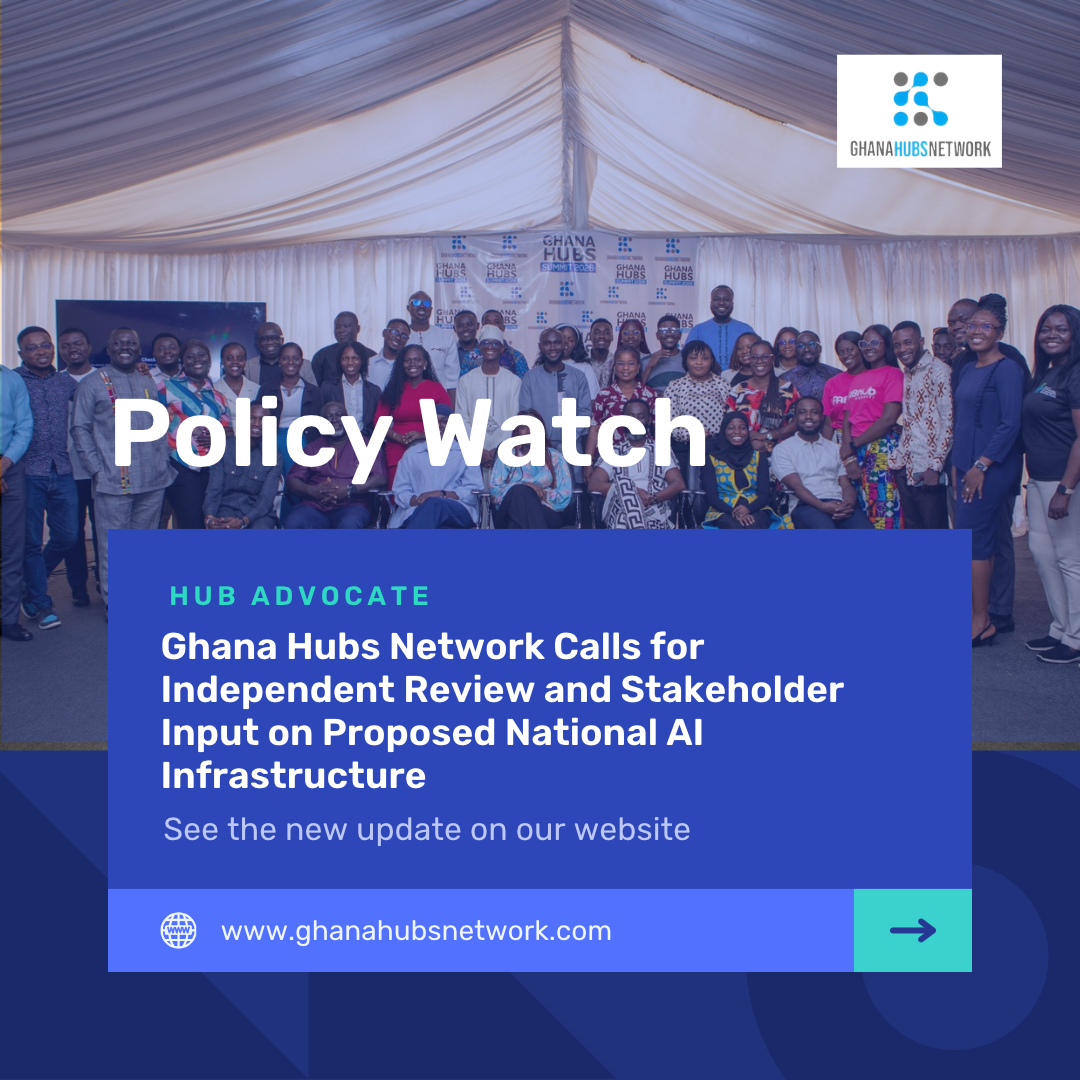
Observations on digital transformation, infrastructure sustainability and Ghana’s innovation economy
Background
The Ghana Hubs Network (GHN) welcomes the Government’s commitment to national AI computing capacity. Cabinet has approved US$250 million for a national AI computing centre. Speaking at Joy News’ Digital Economy Forum on AI and the Ghana Economy, the Minister for Communication, Digital Technology and Innovations, Hon. Samuel Nartey George, said Phase One is expected to be completed within 24 months and that procurement with the Public Procurement Authority is under way. The President has also committed US$20 million to the short- to medium-term implementation of the National AI Strategy (2025–2035).
GHN supports the ambition to make Ghana “Africa’s AI lab”. Reliable, affordable computing can help startups build and test AI products, enable more advanced research, support digital public services and strengthen local businesses.
Infrastructure of this scale also needs transparent investment decisions and a sustainable operating model. Its value will depend on what it costs to run, the demand it serves, the resources it consumes and the opportunities it creates for Ghanaian businesses and researchers.
GHN’s position: Ghana should pursue AI infrastructure that it can sustainably operate, that its innovators can meaningfully access, and that delivers measurable economic and social value.
1. Ambition and operational readiness
AI computing facilities need more than buildings and processors. Depending on scale and configuration, they may require substantial electricity capacity, specialised cooling, reliable connectivity, strong cybersecurity, skilled staff and continuous investment in maintenance and replacement.
GHN is not suggesting the project will worsen electricity or water supply challenges. Our observation is that the added demand, its cost and the safeguards for other users are not yet publicly set out.
An independent feasibility assessment would typically examine:
- The proposed site and its grid connection.
- Projected electricity and water demand.
- Cooling technology.
- Connectivity, backup arrangements and operational resilience.
With procurement under way, these questions are best settled before major financial commitments are locked in.
2. Cost and economic value
The US$250 million for the Phase One computing centre and the US$20 million for National AI Strategy implementation are separate allocations. Public information on the scope, status, financing and intended outcomes of each, and how they relate to later phases, remains limited.
The full picture requires looking beyond construction and equipment to the total cost of ownership over the facility’s life:
- Construction and supporting infrastructure.
- Computing hardware and future upgrades.
- Electricity, cooling, water and connectivity.
- Staffing, cybersecurity, maintenance and physical security.
- Financing costs and equipment replacement.
- Operating subsidies and long-term fiscal exposure.
Projected demand, utilisation, pricing and revenue, and the expected benefits for government, universities, research institutions and private enterprises, are equally important.
AI hardware ages quickly, and underused capacity becomes an expensive asset. Value for money, the distribution of benefits and the financial risk that may fall on taxpayers are therefore central questions.
Credible alternatives also merit comparison with direct public investment: commercial cloud services, colocation, shared research computing, public-private partnerships and phased development. GHN does not favour any model in advance. The right combination depends on Ghana’s needs, finances and technical capacity.
3. Electricity, water and environmental sustainability
Actual electricity and water needs depend on computing capacity, processor types, utilisation, cooling efficiency and climate. A sustainability assessment, undertaken with the relevant power, water and environmental institutions, would establish:
- Projected electricity demand under normal and peak conditions.
- The reliability, cost and resilience of the power supply, including backup.
- Expected water consumption, its source and implications for surrounding communities.
- The suitability of closed-loop and low-water cooling.
- Opportunities for renewable energy, storage, efficiency measures and treated wastewater, where technically and economically feasible.
The findings would inform site selection, technology choices and environmental safeguards. Households, hospitals, schools, farms and businesses depend on the same power and water systems, so the project is best planned to complement national infrastructure and avoid preventable competition for essential resources.
Sustainability belongs in the design and operating model from the start.
4. A phased approach informed by evidence
The success of AI computing infrastructure depends on grid capacity, operating costs, water availability, equipment renewal, commercial demand and access arrangements, not only on the technology installed. Other countries’ experience is useful, but their energy, water and financial systems differ from Ghana’s.
The Minister has himself described Phase One as the first step in a long journey. A phased approach is consistent with that view: it allows demand to be validated, operating assumptions tested, local technical capacity built and capacity expanded as needs become clear. Existing commercial infrastructure, cloud services and research computing facilities could complement national capacity in the meantime.
This is not an argument for lowering Ghana’s digital ambitions. It is an observation that those ambitions are best pursued through an implementation model that manages risk, preserves flexibility and supports long-term sustainability.
5. Ghanaian businesses, startups and researchers
For GHN, the measure of this investment is the opportunity it creates for Ghanaian innovators and enterprises. The Minister has noted that researchers, industry and universities currently buy computing capacity from providers outside Ghana. If the facility is to change that, Ghana’s own startups, SMEs, universities, researchers, developers and innovation hubs need practical access to it, alongside government institutions and large technology firms.
An access and utilisation framework would typically address:
- Affordable, transparent pricing for startups, researchers and small businesses.
- Access arrangements for universities, innovation hubs and other ecosystem organisations.
- Opportunities for Ghanaian developers to build, test and commercialise AI applications.
- Research collaboration, skills development and technology transfer.
- Opportunities for local firms in procurement, operations, maintenance and support services.
Without real demand and practical access, even advanced infrastructure may deliver less value than expected. The facility is best judged not only on computing capacity, but on its contribution to enterprise growth, research, productivity, employment, local technical capability and the competitiveness of Ghana’s digital economy.
6. Areas that warrant attention in planning
In light of the Phase One timeline, GHN identifies six areas that are central to the project’s long-term success:
1. Independent feasibility assessment
Undertake an independent assessment covering technical requirements, projected demand, financial viability, infrastructure readiness, environmental implications, cybersecurity, operational capacity and alternative delivery models.
2. Transparent investment and operating costs
Set out the scope and status of announced allocations, financing arrangements, recurring expenditure, equipment renewal requirements and potential fiscal risks to provide a clearer picture of the project’s long-term financial commitments.
3. Comparative assessment of delivery options
Evaluate direct public investment, private-sector provision, public-private partnerships, cloud services, colocation, shared research facilities and phased development against common criteria, including cost, resilience, strategic value and accessibility.
4. Structured stakeholder consultation
Engage the Ghana Hubs Network, startups, innovation hubs, universities, research institutions, telecommunications operators, data-centre providers, energy and water-sector stakeholders, private investors and civil society organisations.
5. Phased implementation and accountability
Ensure capacity and expansion decisions are informed by demonstrated demand, affordability and infrastructure readiness. Establish periodic reviews of utilisation, operating costs, accessibility and economic benefits to guide implementation and future expansion.
6. Public-benefit and access commitments
Establish clear commitments on affordable computing, opportunities for Ghanaian businesses, local skills development, research collaboration, environmental safeguards and transparent reporting on operational and economic performance.
GHN can contribute perspectives from innovation hubs, startups and other ecosystem actors to help identify local computing needs, assess potential demand and inform practical access arrangements.
Conclusion: Evidence before scale, consultation before commitment
Ghana has a real opportunity to strengthen its digital economy and benefit from growing AI adoption. That deserves ambition, and it also demands sound planning, transparent investment decisions and responsible management of public resources.
The choice is not digital transformation versus reliable electricity and water. Ghana needs both, with investments designed to complement each other. With Phase One targeted within 24 months and procurement under way, its technical requirements, financing, operating model and intended beneficiaries are best clarified as early as possible.
GHN supports efforts to expand Ghana’s capacity to participate in the global AI economy. The goal is not simply to build a computing centre. It is to establish AI infrastructure that Ghana can sustain, that Ghanaian innovators can access, and that delivers measurable value to the wider economy.
Issued by: Yaw Adu-Gyamfi, Chairperson, Ghana Hubs Network
Contact: Chairperson@ghanahubsnetwork.com
